library(tidytext)
library(ggtext)
library(showtext)
library(stringr)
library(tidyverse)
library(here)
library(readxl)
library(ggalluvial)
library(ggsankey)13.Ecosystems
Relationships
Sankey
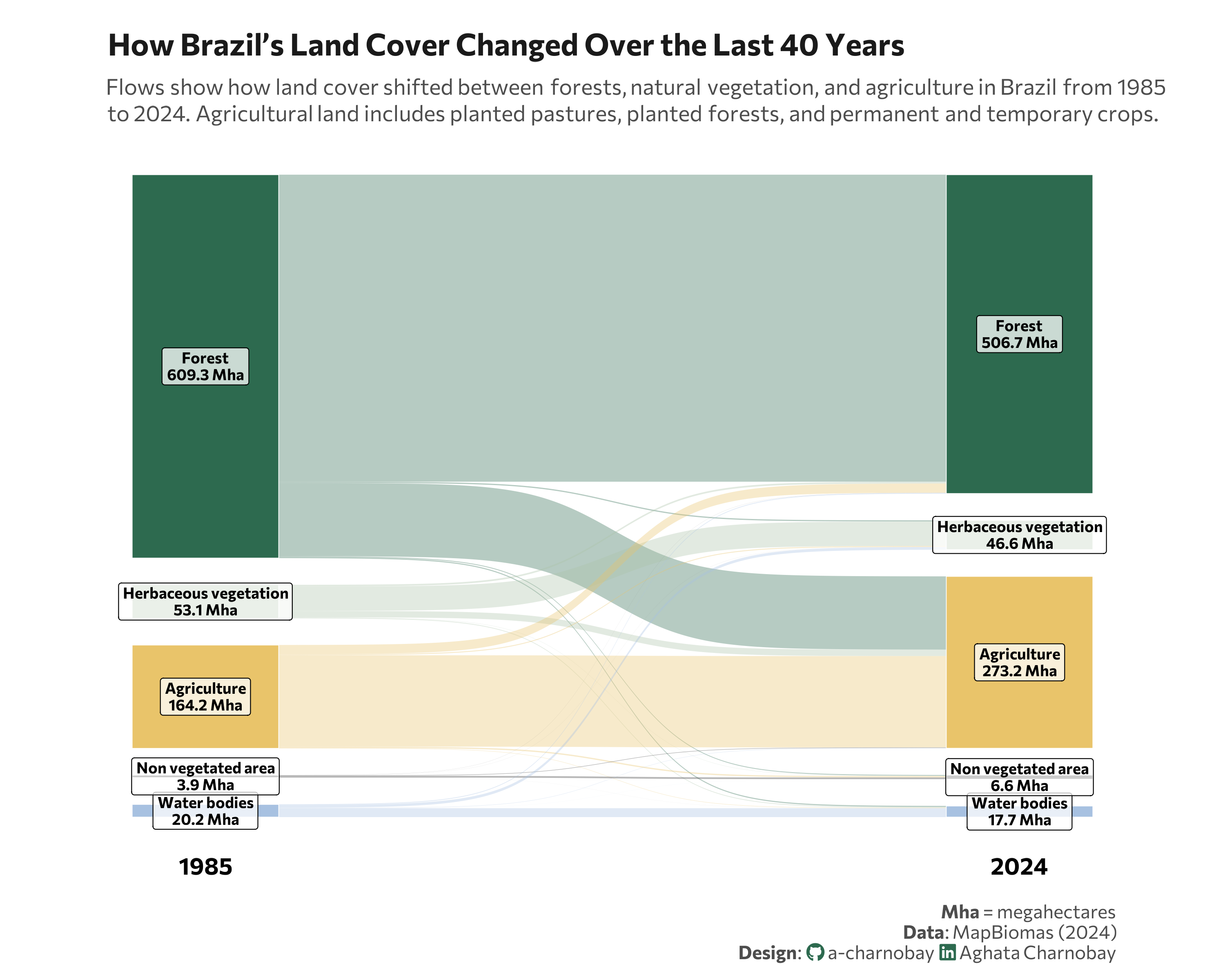
1 Setup
1.1 Load R packages
1.2 Load data
df <- read.csv("sankey_diagram.csv")
colnames(df) <- c("start", "end", "area")
1.3 Set theme
# Font setup
font_add_google("Commissioner")
showtext_auto()
showtext_opts(dpi = 300)
font_main <- "Commissioner"

# Font Awesome for caption
font_add(family = "fa-brands", regular = here("fonts", "Font Awesome 7 Brands-Regular-400.otf"))

# Colors
title_col <- "grey10"
text_col  <- "grey30"
bg_col    <- "#F2F4F8"

ecosystem_colors <- c(
  "Forest" = "#2D6A4F",
  "Agriculture" = "#E9C46A",
  "Herbaceous vegetation" = "#ADC2A9",
  "Water bodies" = "#A7C1E1",
  "Non vegetated area" = "grey20"
)
2 Prepare data for plotting
target_order <- rev(c(
  "Forest",
  "Herbaceous vegetation",
  "Agriculture",
  "Non vegetated area",
  "Water bodies"
))

df_sankey <- df |>
  mutate(
    area_mha = as.numeric(area) / 1000000,
    across(c(start, end), ~case_when(
      . == "Herbaceous and Shrubby Vegetation" ~ "Herbaceous vegetation",
      . == "Farming" ~ "Agriculture",
      . == "Water and Marine Environment" ~ "Water bodies",
      TRUE ~ .
    ))
  ) |>
  make_long(start, end, value = area_mha) |>
  group_by(x, node) |>
  mutate(label_full = paste0(node, "\n", round(sum(value, na.rm = TRUE), 1), " Mha")) |>
  ungroup() |>
  # Now levels = target_order will find the shortened names correctly
  mutate(
    node = factor(node, levels = target_order),
    next_node = factor(next_node, levels = target_order)
  )
3. Plot
p <- ggplot(df_sankey, aes(x = x,
next_x = next_x,
node = node,
next_node = next_node,
fill = node,
label = label_full,
value = value)) +
geom_sankey(flow.alpha = 0.35,
node.color = "white",
node.size = 0.2,
width = 0.18) +
# Labels
geom_sankey_label(size = 3.2,
color = "black",
fill = "white",
alpha = 0.75,
family = font_main,
fontface = "bold",
label.size = NA,
lineheight = 0.9) +
scale_x_discrete(labels = c("1985", "2024"), expand = c(.06, .06)) +
scale_fill_manual(values = ecosystem_colors) +
# Labs
labs(
title = "How Brazil’s Land Cover Changed Over the Last 40 Years",
subtitle = "Flows show how land cover shifted between forests, natural vegetation, and agriculture in Brazil from 1985<br> to 2024. Agricultural land includes planted pastures, planted forests, and permanent and temporary crops.",
caption = paste0(
"**Mha** = megahectares",
"<br>**Data**: MapBiomas (2024)",
"<br>**Design**: <span style='font-family:fa-brands; color:#2D6A4F;'></span> a-charnobay ",
"<span style='font-family:fa-brands; color:#2D6A4F;'></span> Aghata Charnobay"
)
) +
# Styling
theme_minimal(base_family = font_main) +
theme(
plot.title = element_text(face = "bold", size = 18, color = title_col, margin = margin(t = 10, b = 10)),
plot.subtitle = element_markdown(size = 13, color = text_col, margin = margin(b = 10), lineheight = 1.2),
plot.caption = element_markdown(size = 11, color = text_col, margin = margin(t = 15), lineheight = 1.1),
plot.title.position = "plot",
plot.margin = margin(10, 20, 10, 20),
panel.grid = element_blank(),
axis.title.x = element_blank(),
axis.text.x = element_text(face = "bold", size = 14, color = "black"),
axis.title.y = element_blank(),
axis.text.y = element_blank(),
legend.position = "none",
aspect.ratio = 0.7
)